
Signs of Autism in Early Childhood: How to Identify Them by Age
Dr. Fátima Olalla
Autism Spectrum Disorder (ASD) can begin to show hints in the first months of life — but these signs are not always easy to recognize. As a clinical psychologist specializing in child intervention and home-based care, I often work with families who feel that “something doesn’t quite fit” in their child’s development, yet they don’t know whether to worry.
Identifying early signs doesn’t mean labelling, but rather observing social, communication, and sensory development — in order to intervene as early as possible. Scientific evidence shows that the earlier support begins, the better the prognosis.
In this guide you will find a clear, up-to-date explanation of the most common signs, plus a complete, age-based chart grounded in developmental milestones.
What is ASD — and why it’s important to detect it as early as possible
Autism Spectrum Disorder (ASD) is a neurodevelopmental condition that affects mainly:
The core challenges of Autism Spectrum Disorder (ASD)
ASD is characterised by a constellation of developmental challenges across various areas. These do not manifest in exactly the same way in every individual — which underlines the idea of the “spectrum.” Below are the main domains typically affected, with an expanded explanation of each:
1. Social Interaction and Communication
This is a central pillar in the definition of ASD. Difficulties in this area often involve both social and communicative dimensions, which are frequently intertwined:
Deficits in socio-emotional reciprocity: Children may struggle to initiate or respond to social interactions, share interests or emotions, or engage in back-and-forth exchanges in play or conversation. This can look like a lack of interest in others — or, sometimes, unusual or contextually inappropriate social approaches.
Challenges in non-verbal communication: Difficulty understanding or using gestures, eye contact, posture, facial expressions, or other non-verbal cues to regulate social interaction. A child with ASD may have trouble interpreting others’ body language — or their own non-verbal communication may be hard for others to read.
Difficulties developing and maintaining relationships: Individuals on the spectrum often find it hard to make friends, maintain relationships, or understand the flexible, implicit social “rules” in group dynamics. This doesn’t necessarily mean they don’t want friendships — but that applying subtle social norms can be challenging.
2. Behavior — including Repetitive Patterns and Narrow, Intense Interests
This domain reflects the need for predictability and the intensity of certain behaviours or focus of attention:
Stereotyped or repetitive movements, use of objects or speech: This may show as repetitive motor behaviours (e.g., hand-flapping, spinning or rocking), repetitive use of objects (e.g., lining up toys in a very specific way), or repeated phrases/echolalia (immediate or delayed repetition of words or sentences). These behaviours often help the child self-regulate or cope with sensory overload.
Strong insistence on routines or rigid adherence to patterns: Even small changes in the environment or daily routine — like taking a different route to school or changing the order of meals — may cause significant distress or anxiety.
Highly restricted, focused and intense interests: The child may show intense fascination for very specific topics (for example trains schedules, dinosaurs, vacuum cleaners) and devote disproportionate time and energy to them — often to the exclusion of other interests.
3. Sensory Processing — which can be Hypersensitive or Hyposensitive
Differences in how the brain processes sensory information are now widely recognized as a key feature of ASD. This can involve any of the five senses (sight, hearing, touch, taste, smell), and also vestibular (balance/movement) or proprioceptive (body awareness) senses:
Hypersensitivity: Overreaction to what would be mild sensory stimuli for other children. For example: extreme discomfort with everyday noises (vacuum cleaner, hand-dryer), aversion to certain textures of clothing or food, distress at bright lights.
Hyposensitivity (sensory-seeking or under-reactivity): Diminished or muted response to sensory stimuli — or even a need to seek strong sensory input. For example: constant movement (spinning, jumping), seeming insensitivity to pain or temperature, or a strong urge to touch surfaces or people intensively.
4. Language Development and Other Cognitive Skills
Although this overlaps with communication, this area focuses more on formal language acquisition and associated cognitive abilities:
Delayed or absent spoken language: Some children with ASD may never develop functional spoken language; others may have a significant delay before beginning to speak.
Unusual use of language: Even when speech develops, it might feature a monotonous tone of voice, difficulties grasping non-literal language (irony, metaphors), overly formal or repetitive phrasing.
Uneven cognitive profile: It is common to observe a mix of strengths and difficulties. Some children may show remarkable skills in certain areas (visual memory, calculation, music), while struggling—with executive function, flexibility, or “theory of mind.”
You might picture it as a child trying to navigate the world with an incomplete social map — and a sensory compass that fluctuates in sensitivity. This can lead to difficulties interpreting gestures, making eye contact, handling changes — and a need for stability through routines or repetitive behaviors.
Why Early Detection Matters
Enables early, personalized support: Early detection allows for a thorough, individualized assessment of each child’s strengths, challenges, and sensory profile. Based on that assessment, customized support plans (such as Individualized Education Programs or therapeutic strategies) can be designed to address key areas: communication, social interaction, autonomy, emotional regulation — aligned with the child’s developmental needs and context.
- Promotes development of social and communication skills: Early intervention helps build meaningful social and communicative abilities: both verbal and non-verbal — including, when needed, alternative communication systems. It also helps with emotional regulation in social settings and supports participation in group activities in a satisfying, functional way.
- Supports and empowers families: Detecting early gives families access to guidance, education about autism, behavioral strategies at home, and emotional support. This helps create a structured, understanding environment at home — enabling parents or caregivers to be active collaborators in their child’s development.
- Helps regulate sensory challenges: Early support can address sensory processing differences — whether hypersensitivity or sensory-seeking behaviours — reducing anxiety, stress or disruptive behaviour, and facilitating regulation and readiness for learning.
- Improves long-term prognosis and quality of life: When intervention starts early and is continuous, it can maximize the child’s developmental potential — promoting greater independence in adulthood (decision-making, employment, housing), social inclusion, emotional and physical well-being, and a fulfilling adult life.
Signs of Autism in Childhood
Although every child is different, certain patterns are commonly considered warning signs by research and clinical guides.
Social Interaction & Communication — Typical Signs
These characteristics often point to difficulties in social communication and interaction, which are essential for typical development and participating fully in everyday life.
- Regression in language or development: Some children may lose previously acquired skills — for example, language or eye contact — often noticeable around 18 months. This loss can be part of the natural course of autism.
- Inconsistent or minimal response to their name: The child might not respond when called, or respond only inconsistently or after a delay — especially when there are no other stimuli around.
- Reduced or unusual eye contact: The child may avoid sustained eye contact, look away, or keep gaze fleeting or unfocused. Rather than using eye contact to share attention or emotions, they may appear indifferent to it.
- Difficulty initiating or maintaining social interactions: The child may rarely approach other people to play or talk, and may struggle to sustain back-and-forth social interaction — whether with peers or adults.
- Limited use of communicative gestures: Such as pointing to show interest, waving goodbye, nodding/shaking head — gestures that typically support preverbal communication may be absent or infrequent.
- Lack of shared interest or joint attention: The child might seldom use gestures or words to draw another person’s attention to something they find interesting (“look at that!”) — a key skill for social learning and emotional connection.
- Challenges understanding or imitating social expressions: Difficulty interpreting facial expressions, tone of voice or body language — or using their own expressions — can hinder emotional reciprocity.
Language and Non-Verbal Communication
Difficulties in language development and non-verbal communication are often among the first signs noticed in children with autism.
- Delayed verbal language development: The child may not meet language milestones typical for their age — e.g., not babbling, not saying simple words, or not forming short sentences when expected.
- Loss of previously acquired language skills: A child may begin to speak or babble, but then lose those skills. This “regression” is a strong reason for clinical evaluation.
- Echolalia (repetition of words or phrases): The child may repeat words, sentences, or parts of speech — immediately after hearing them, or later (for example, quoting dialogue from a film). While this may seem meaningless, sometimes it serves to communicate needs or self-regulate.
- Difficulty using language for social purposes (pragmatics): Even if vocabulary or grammar seem adequate, the child may struggle to start or sustain a conversation, take turns, use language to share feelings or intentions, adapt language to the listener or context, or understand non-literal language (e.g., irony, metaphors).
- Atypical non-verbal communication: Problems with gestures, body language, facial expressions, tone of voice or other non-verbal cues may affect communication, even when speech is present.
Behaviour, Interests, Play & Sensory / Motor Patterns
Autism often involves behaviours, interests, sensory responses, or ways of playing that are repetitive, restricted or different from typical development. Some of these signs include:
- Repetitive motor behaviours or stereotypies: Hand-flapping, rocking, spinning, repetitive manipulation of objects — e.g., lining toys up, focusing on parts of objects (like wheels) rather than using them as intended.
- Intense, narrow or unusual interests: A strong fascination with specific, sometimes odd topics (objects, patterns, sounds, etc.) and spending a lot of time focused on them.
- Strong adherence to routines and resistance to change: The child may become very upset or anxious when daily routines, routes, sequence of activities or environment change, even slightly.
- Limited or unusual play: Instead of symbolic or imaginative play typical for their age, they may prefer repetitive exploration of sensory properties of objects or mechanical aspects, rather than pretending or using objects symbolically.
- Sensory processing differences: Unusual reactions to sounds, textures, lights, tastes, smells or movement. This can include hypersensitivity (over-reacting) or hyposensitivity (under-reacting or seeking intense sensory input).
Additionally, sensory or sensory-motor differences can impact eating, sleeping, emotional regulation, and daily functioning — often increasing stress or discomfort, especially when environment or routines change.
Why this Matters: Early Signs ≠ Labels — Early Detection = Opportunity
Early signs (especially in social-communication, language, behaviour or sensory processing) often appear before age 3.
- Because every child is unique, the presence of one or some signs doesn’t necessarily mean autism — but when several are present regularly and persistently, it can be a cue to seek professional evaluation.
- Detecting and acknowledging these signs early allows caregivers, paediatric professionals, therapists and educators to monitor development closely, and — if needed — to plan early, tailored support. This can make a significant difference in a child’s development, communication, learning and long-term well-being.
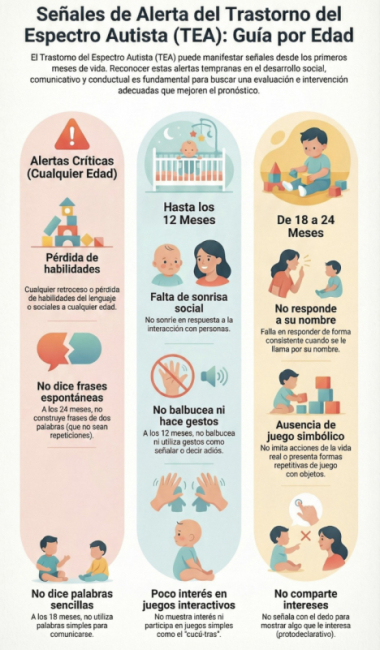
Alert signs of ASD by age
Below is a clear infographic based on age-related detection of ASD:
Screening Tools and When to Request an Evaluation
Early detection of Autism Spectrum Disorder (ASD) is crucial to optimize development, and standardized screening tools are a cornerstone in primary care.
The M-CHAT-R/F is an internationally validated screening questionnaire, recommended between 16 and 30 months during pediatric check-ups to identify risk of ASD. Its follow-up version (the “/F”) helps reduce false positives.
No tool replaces clinical judgment. Continual clinical observation — starting as early as 6 months, monitoring social milestones (smile, eye contact, joint attention) — is key to detecting early deviations.
A reliable, formal diagnosis of ASD is generally established around the age of 2 years by specialized professionals, using comprehensive assessments such as the ADOS-2 and the ADI-R.
It is vital to refer to specialized care at any age if there are well-founded concerns — avoiding a “wait and see” approach — because any delay or atypical pattern in social or communication development justifies starting the process immediately.
As experts in the field, we emphasize the importance of hearing (audiological) evaluation in young children as part of the diagnostic process, since lack of response may stem from hearing issues rather than ASD.
An important part of early diagnosis is an etiological evaluation (genetic testing in many cases) and ruling out serious neurological conditions — such as certain forms of epilepsy or metabolic disorders. Therefore, it’s essential that, besides psychological assessment, a neuropediatric evaluation be conducted for any child with suspected ASD.
What to Do If You Suspect Your Child Might Have ASD
Do you suspect your child may have Autism Spectrum Disorder (ASD)? Early, tailored intervention can make a profoundly positive and lasting difference. We recommend the following steps:
Observe calmly and take notes of repeated behaviours.
Share your concerns with a child psychologist.
Request a developmental evaluation if you notice several warning signs.
Don’t wait until “they’ll talk someday” or “it will pass”: early intervention can make all the difference.
In many cases, an appropriate intervention may lead to noticeable improvements in key areas:
Eye contact and joint attention: Efforts may focus on increasing eye contact frequency and quality, helping foster more meaningful connection with others and improving the ability to share attention when focusing on an object or event — a skill crucial for social learning and language.
Communication (verbal and non-verbal): The aim is to expand the child’s communicative repertoire, which may include encouraging spoken language development (articulation, vocabulary, syntax) or introducing augmentative and alternative communication (AAC) systems; also improving the use and understanding of gestures, facial expressions, and body language.
Social skills and reciprocal interaction: This includes helping the child learn to start, sustain and end social interactions appropriately: learning social norms, perspective taking, empathy, and playing or interacting with peers in a flexible, cooperative way.
Emotional and behavioural regulation: The child learns strategies and tools to identify, understand and manage their own emotions (e.g. frustration, anxiety). This leads to better self-regulation, a reduction in challenging or disruptive behaviours, and increased resilience.
Sensory regulation and sensory integration: Addressing hypersensitivity or hyposensitivity to sensory input (visual, auditory, tactile, olfactory, taste, vestibular or proprioceptive). The goal is to help the child process and respond to sensory information more organizedly and functionally — reducing overload and enabling better participation in everyday activities.
If you need support, we offer home-visit child psychology services in Madrid.
The early-childhood signs of autism can be subtle or very evident, but it is always essential to observe development with an open, evidence-based perspective. The purpose is not to push for premature diagnoses — but to ensure that each child receives appropriate support at the right time.
If you have concerns about your child’s development, remember: seeking professional guidance is an act of care. Early detection allows us to better support their growth, foster their abilities and promote their emotional well-being.
